The KS2 Skills That Matter Most for a Confident Start to Year 7

Mark Day • 22 September 2026

Year 6 is often remembered for SATs preparation, school trips, and end-of-year leavers’ assemblies. Behind those milestones, however, sits an even larger transition: the leap into secondary school. When children step into Year 7, the environment shifts dramatically. Instead of one primary class teacher who knows their learning style inside out, they encounter up to ten different teachers, separate subject books, specialised vocabulary, and a much faster curriculum pace.


Many parents wonder whether their child is truly prepared. Academic readiness for Year 7 is rarely about knowing every fact in advance. Instead, it comes down to a small handful of core academic foundations and everyday study habits that give children the resilience to keep up without feeling overwhelmed.


Focusing on reading comprehension, writing stamina, times tables, fractions, organisation, and personal independence during Year 6 builds the practical toolkit every child needs for a confident start.


1. Reading Comprehension Across Different Subjects


In primary school, reading often centres around literacy lessons, guided reading, and class novels. At secondary school, reading suddenly becomes the vehicle through which children learn almost every subject. A Year 7 student must read and extract meaning from dense science experiment sheets, complex historical sources, wordy geography case studies, and multi-step exam questions.


A child who reads mechanically without strong comprehension skills will often tire quickly and miss subtle instructions. Building solid comprehension in Year 6 means encouraging children to read for deeper meaning rather than speed. Useful habits include discussing short newspaper articles together, asking why a character made a specific choice, and encouraging them to summarise a page in their own words before moving on.


2. Writing Stamina and Fluency


One of the sharpest shocks in Year 7 is the sheer physical and mental demand of writing. In secondary lessons, pupils frequently move between taking timed notes from a whiteboard, writing extended paragraphs in English or history, and completing structured homework tasks on the same evening.


Children who struggle with writing stamina often find that their hands ache, their focus drifts, and their work appears rushed or unfinished, even when they understand the concepts perfectly. In Year 6, building stamina is not about copying pages from textbooks; it is about encouraging regular, fluent writing in short, sustained bursts. Writing ten minutes of diary entries, book reviews, or creative descriptions without stopping helps strengthen hand muscles, improves sentence variety, and ensures children do not feel intimidated by longer Year 7 written assignments.


3. Automatic Times Tables Recall


Secondary maths moves at a brisk pace. Topics such as ratio, algebraic substitution, prime factor trees, percentages, and area formulas all rely on one fundamental baseline: fast, automatic multiplication recall.


If a child must pause to count on their fingers or calculate what seven times eight equals, their working memory quickly becomes clogged before they can tackle the actual problem. Automatic recall up to 12 × 12 frees up cognitive space so pupils can concentrate on multi-step reasoning. Short, low-stress practice sessions—whether via five-minute oral quizzes in the car, cards, or digital games—make an immense difference to how capable a child feels when secondary maths begins.


4. Confidence with Fractions


Fractions are notorious for causing dips in confidence toward the end of Key Stage 2, and that hurdle carries directly into Key Stage 1 and 2 transition. In Year 7 maths, fractions form the gateway to decimals, percentages, probability, and algebra.


When children view fractions purely as abstract rules to memorise—such as “flip and multiply” without understanding why—the steps quickly blur together under pressure. Taking time in Year 6 to ensure your child grasps equivalence, simplifying, finding common denominators, and linking fractions to real-world visual models pays enormous dividends. A child who feels at ease with fractions approaches secondary maths lessons with genuine confidence rather than dread.


5. Everyday Organisation: Bags, Planners, and Books


The academic side of secondary school is closely tied to practical organisation. In Year 7, children must remember separate exercise books for each subject, pack PE kits, carry rulers, protractors, and calculators, and track deadlines across multiple online school platforms or planners.


When organisation breaks down, it creates morning panic, lost break times, and unnecessary stress that bleeds into the classroom. You can help your Year 6 child cultivate these habits at home right now. Have them take ownership of packing their own school bag the night before, checking off their equipment against a checklist, and keeping a dedicated, tidy homework desk space where papers and stationery live.


6. Independence and Asking for Help


Perhaps the most underrated Year 7 skill is the self-assurance to speak up when something is unclear. In a class of thirty pupils with different teachers throughout the day, teachers cannot always spot a quiet student who is quietly falling behind or feeling lost.


Secondary-ready children have learned that getting stuck is part of learning, not a failure. Encouraging your Year 6 child to attempt a problem independently for five minutes before asking, and then helping them articulate where they got stuck, gives them the voice they need to thrive in a larger secondary school setting.


How Empower Tutoring Helps Build Secondary-Ready Confidence


The final year of primary school is the ideal window to reinforce these vital skills without the looming pressure of secondary deadlines. At Empower Tutoring in Waltham Abbey, Essex, our tailored Key Stage 2 and Year 7 transition programmes are designed to close small learning gaps, sharpen maths fluency, enhance English comprehension, and nurture genuine academic confidence.


Whether your child needs a gentle boost with fractions, support with writing stamina, or structured preparation to make the leap into Year 7 calm and successful, our individualised approach ensures they feel capable, proud, and fully secondary-ready. Get in touch today to discuss how we can support your child’s journey.

by Mark Day • 24 August 2026
Starting secondary school is a major milestone. For many children, the first few days of Year 7 are exciting. There are new classrooms, new teachers, new subjects and often new friends too. But once the first-week excitement has faded, the reality of secondary school can begin to feel more demanding. This is completely normal. The first half-term is a big adjustment. Children are learning how to navigate a larger school, follow a timetable, manage homework and become more independent. Some will settle quickly. Others may need a little more time, reassurance and support. Here is what parents can expect during the first half-term of Year 7 — and how you can help your child feel more confident as they settle in. 1. Your child may be more tired than usual Secondary school days can feel long. Children are concentrating on new lessons, moving around a bigger building, meeting different teachers and remembering new routines. Even children who seem happy at school may come home tired, quiet or a little irritable. This does not always mean that something is wrong. It often means they are using a lot of energy to adjust. Try to keep after-school time calm where possible. A snack, a drink and a little time to relax before homework can make a big difference. Sleep is important too. A consistent bedtime routine can help children feel more rested and ready for the next day. 2. Organisation can be a challenge at first At primary school, children are often reminded about what they need to do. At secondary school, they are expected to remember more for themselves. That might include: checking their timetable bringing the correct books and equipment completing homework remembering PE kit keeping track of school messages getting ready for the next day It can feel like a lot. A simple evening routine can help. Encourage your child to check their timetable, pack their bag and get their uniform ready before bed. A checklist can be useful in the first few weeks. The aim is not to do everything for them. It is to help them build habits they can manage independently over time. 3. Homework may feel different One of the biggest changes in Year 7 is homework. Children may have tasks from several subjects at once. They may need to use a planner, online platform or school app to keep track of deadlines. At first, this can feel overwhelming. Some children will say they have no homework because they have forgotten to write it down. Others may leave it until the last minute because they do not know where to begin. Try to create a regular homework routine. This could mean a short, quiet period after school or after dinner. Keep the space calm and free from distractions if possible. If a task feels large, help your child break it into smaller steps. For example: Read the task carefully. Decide what equipment is needed. Spend ten minutes making a start. Take a short break. Return to it if needed. A little structure can make homework feel far more manageable. 4. Friendships may take time to settle Friendships can change when children move to secondary school. Some children arrive with familiar friends. Others may be placed in tutor groups with children they do not know well. It is common for friendships to shift during the first few weeks. Try not to panic if your child does not immediately have a close friendship group. Making friends takes time. Encourage them to be friendly, join in and speak to different people. Clubs, sports and lunchtime activities can also help children meet others with similar interests. If they are worried about friendships, listen first. Avoid dismissing their concerns, even if they seem small to you. Feeling heard can be very reassuring. 5. Confidence can dip before it grows A child who felt confident in Year 6 may suddenly feel less sure of themselves in Year 7. They are no longer one of the oldest children in school. The work may feel harder. Lessons may move faster. They may be surrounded by new people. This can lead to comments such as: “I’m not good at maths.” “Everyone else understands it.” “I don’t know what I’m doing.” “I hate homework.” Try to remind your child that no one is expected to know everything straight away. The first half-term is about learning how secondary school works. Praise effort, organisation and perseverance, rather than focusing only on results. A child who keeps trying and asks for help is making progress, even when they do not feel confident yet. 6. Keep communication open Many children will not give long answers when asked, “How was school?” Try asking more specific questions instead. For example: What was the best part of your day? Which lesson felt easiest today? Was there anything that felt tricky? Who did you sit with at lunch? What do you need to remember for tomorrow? Is there anything you would like help with? These questions can make it easier for your child to talk. They also give you a clearer sense of how they are settling in. Try to make these conversations feel relaxed rather than like an interrogation. A chat in the car, while cooking dinner or before bed may work better than a formal question-and-answer session. 7. Watch for signs your child may need extra support A difficult day now and then is normal. But it may be worth looking more closely if your child seems unhappy or overwhelmed for several weeks. You may notice that they are: regularly avoiding homework becoming very anxious about school losing confidence in a particular subject struggling to stay organised saying they do not understand the work becoming upset or frustrated by small tasks It can help to speak to the school if you have concerns. Sometimes a small issue can be resolved quickly with the right information or support. For some children, a little extra help outside school can also be useful. A calm, individual approach can give children time to revisit tricky areas, ask questions without pressure and rebuild confidence in key subjects. 8. Give them time to adjust The first half-term of Year 7 is not about getting everything right. It is about settling in. Your child is learning a new routine, a new environment and a new level of independence. There will probably be forgotten books, confusing homework tasks and days that feel more difficult than others. That is all part of the process. Try to focus on small wins. Perhaps they found their way around school without help.Maybe they remembered their PE kit, completed homework independently or spoke to someone new. These small steps build confidence over time. How Secondary Ready tutoring can help The move from Year 6 to Year 7 does not end on the first day of term. For many children, the first half-term is when they begin to notice which subjects feel more challenging and where they need more support. Secondary Ready tutoring can provide a calm bridge between primary school and Year 7. Sessions can help children: strengthen key maths and English skills build confidence in asking questions develop homework and study habits become more organised approach Year 7 work with less stress At Empower Tutoring in Waltham Abbey, Essex , support is tailored to the child. The aim is not to add pressure. It is to help children feel more secure, capable and ready to make the most of secondary school. Just get in touch if you would like to find out more about tutoring support in Year 7. Some Final thoughts Starting Year 7 is a big change. It is normal for children to feel excited one day and unsure the next. The most helpful thing parents can offer is calm support, realistic expectations and time to adjust. With the right routines, encouragement and a little help when needed, most children grow in confidence as the weeks go by.
Child smiling at a desk, writing in an open notebook with pencils and books nearby.
by Mark Day • 4 August 2026
Is your child ready for September? Learn how to support your child's return to school and find out how targeted KS2 & Year 7 tutoring can provide a confidence boost.
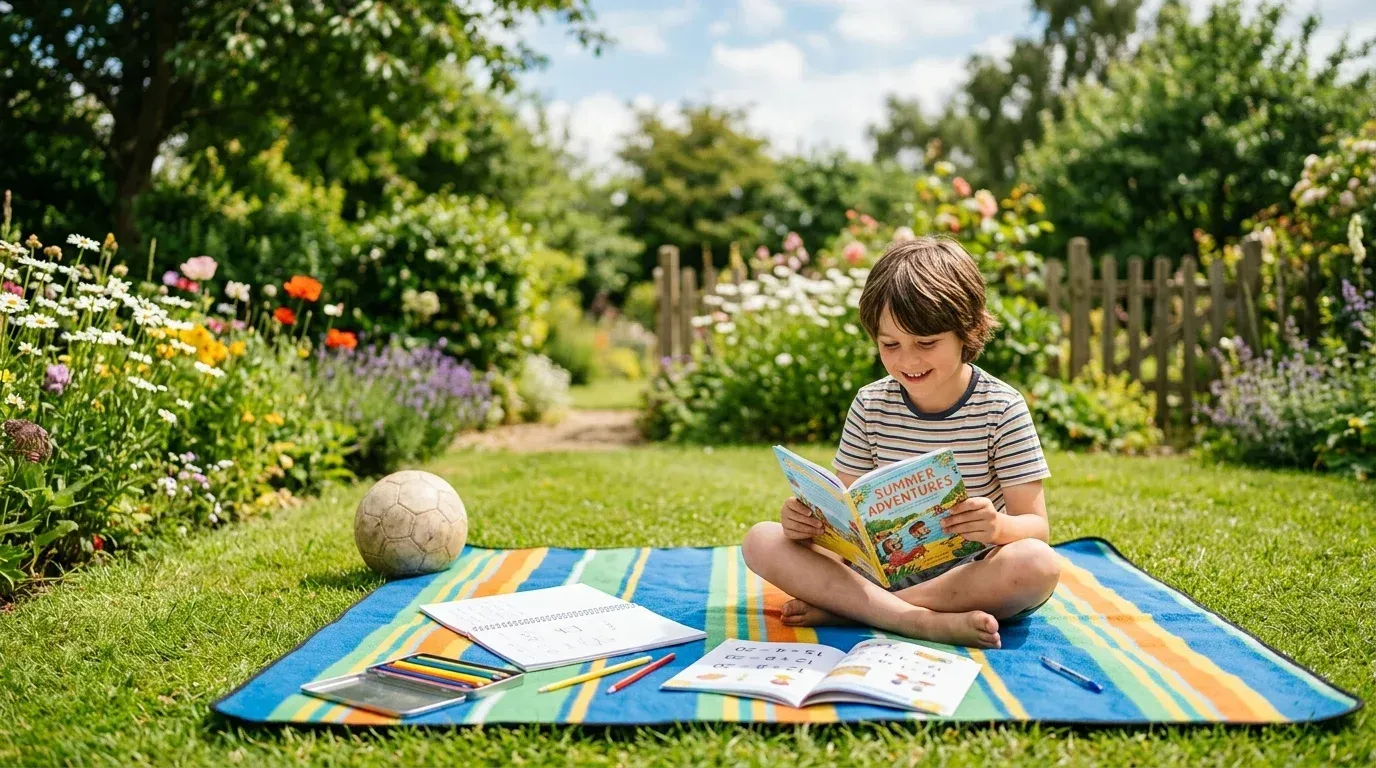
Child reading on a blue picnic blanket in a sunny garden, with papers and a ball nearby.
by Mark Day • 3 July 2026
Help your Year 6 child prepare for secondary school with practical tips on confidence, routines, organisation and key skills for a smoother Year 7 transition.
by Mark Day • 28 May 2026
Simple ways to help your Year 6 child feel confident, organised and secondary ready before starting Year 7 in September.
Five children sitting and reading books with colorful covers outdoors.
by Mark Day • 28 May 2026
Learn fun ways to boost your child's maths skills at home with games, cooking, and DIY projects. Start supporting their learning today!
by Mark Day • 27 April 2026
Learn how to support your child’s calmness & confidence during SATs week. Discover tips for a stable home, sleep, & breakfast.
by Mark Day • 29 March 2026
Learn why writing is a struggle in KS2. Get expert support to improve your child's writing skills today!
Fraction manipulatives including circles and rectangles in various colors, ruler, and pencil on white background.
by Mark Day • 1 March 2026
Learn why KS2 children struggle with fractions & discover effective tutoring strategies to enhance their maths skills. Contact us today!
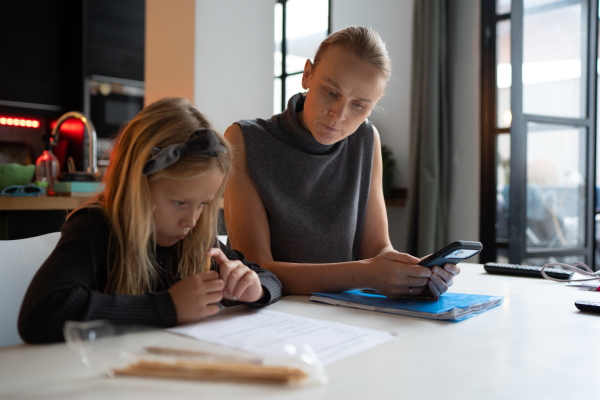
Woman and child at table, looking down at papers and phone. The woman is holding a phone, and they appear to be working together.
by Mark Day • 25 January 2026
Understand KS2 SATs for Year 6 students. Get tips to support your child & reduce stress. Contact us for tutoring help!
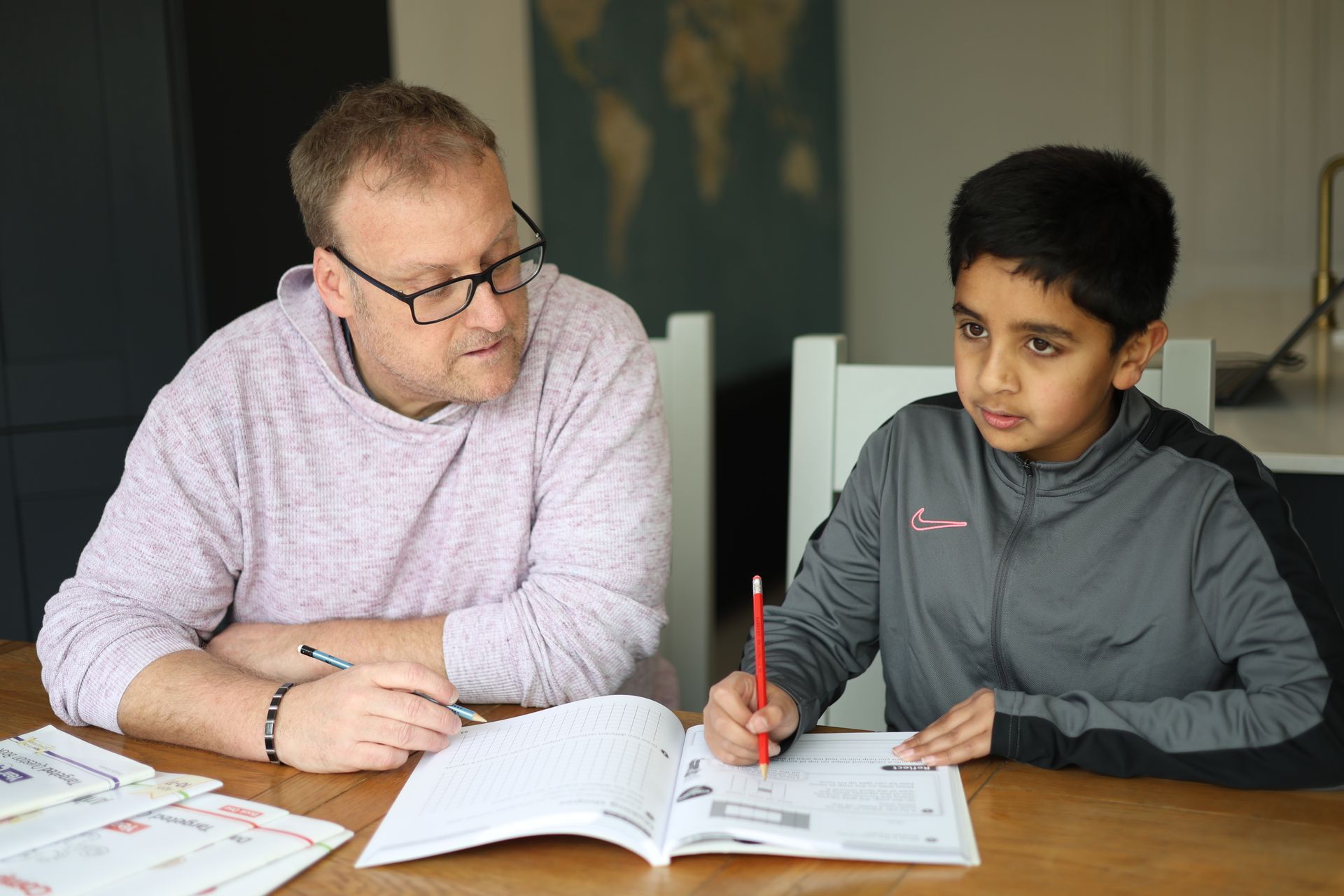
Man in glasses helping a boy with homework at a table. Both are looking at the book.
by Mark Day • 28 December 2025
Learn how KS2 tutors support children in Years 3-6. Boost confidence & understanding. Contact us for tailored tutoring today!